
Turn the fireplace you already have into the one you actually use. We install gas, wood, pellet, and electric fireplace inserts throughout Canton and the Greater Boston area — featuring Majestic, Vermont Castings, and Jotul, with full chimney venting and professional installation.
A fireplace insert is a self-contained, insulated heating appliance designed to be installed directly into an existing open masonry or factory-built fireplace. It essentially acts as a fireplace within a fireplace — sealing the opening to prevent heat loss and significantly improving both energy efficiency and safety.
Traditional open fireplaces are notoriously inefficient, often losing up to 90% of a fire's heat up the chimney. An insert fills that space with a sealed glass-fronted firebox, keeps heated air inside your living space, and turns a decorative fireplace into a functional heating source — often capable of warming an entire living area on a single fuel load.
Inserts are available in four fuel types (gas, wood, pellet, and electric) and are one of the most cost-effective ways to upgrade an existing fireplace without major construction.
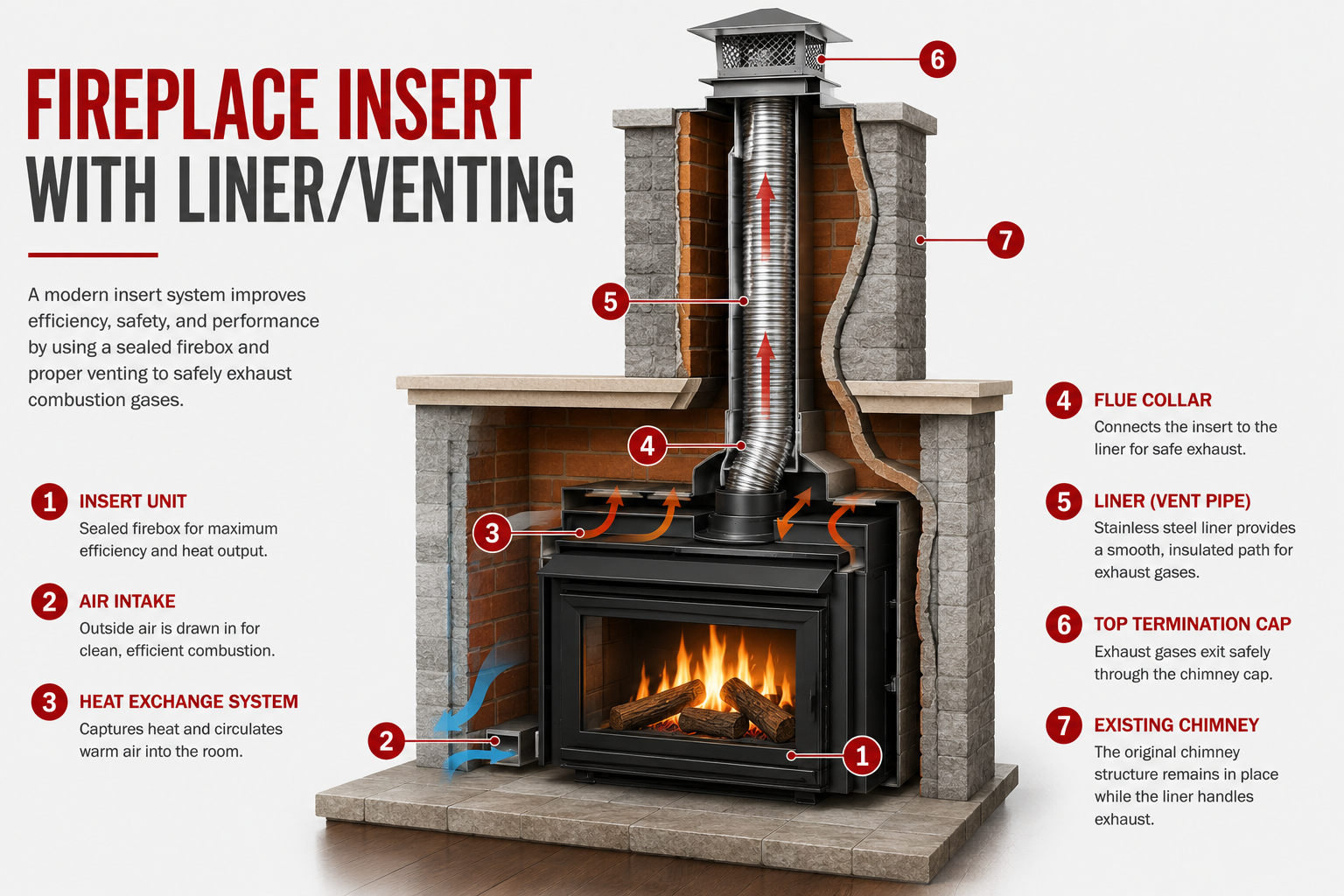
A fireplace insert transforms an open, drafty fireplace into a sealed heating appliance. Here are the seven components that make up a complete insert-and-liner system — and how they work together while the existing masonry chimney stays in place.
The sealed firebox that captures heat and prevents room air from escaping up the chimney — the core of every insert.
Outside air is drawn in for clean, efficient combustion, keeping heated room air where it belongs.
Captures heat from the fire and circulates warm air back into the room via built-in channels or a blower.
Connects the top of the insert to the stainless steel liner for safe, controlled exhaust of combustion gases.
A stainless steel pipe running the full height of the chimney, providing a smooth, insulated path for exhaust gases.
Protects the top of the liner and lets exhaust exit safely, keeping weather and debris out of the venting system.
The original masonry chimney stays in place. The liner does all the venting work — no rebuild required.
A gasketed, glass-fronted door seals the firebox. This prevents your home's already-warmed air from being pulled into the fire and sent up the chimney — the #1 cause of heat loss in open fireplaces.
Hollow metal channels around the firebox act as a heat exchanger. A built-in blower pulls cool room air through the channels, heats it, and pushes it back into your living space.
Modern inserts let you precisely regulate oxygen intake. By restricting the air, you extend the burn time and maintain consistent heat output — impossible with an open-hearth fire.
A stainless steel liner runs from the top of the insert all the way through the existing chimney. All exhaust gases are safely carried outside, bypassing the old, inefficient masonry flue.
Inserts come in four fuel types, and the right choice depends on your home's existing infrastructure, your heating goals, and how much day-to-day involvement you want with your fireplace.
Push-button ignition, remote control, and instant flames. The most convenient option, ideal for homeowners who want reliable heat with minimal effort.
Real flame, real crackle, real wood scent. EPA-certified modern wood inserts are dramatically more efficient than open hearths, with long burn times and high heat output.
Automated hopper feeds compressed wood pellets into the fire for hands-free heating. A middle ground between wood and gas — real combustion, minimal daily involvement.
The simplest option — plugs into a standard outlet, requires no venting, no gas line, no chimney. LED technology simulates flames while providing supplemental electric heat.
An insert transforms an open, drafty hearth into a sealed, high-efficiency appliance — using the exact fireplace opening you already have.
If your existing fireplace is an open masonry unit, the difference an insert makes is significant. Here's the side-by-side.
| Feature | Fireplace Insert | Open Fireplace |
|---|---|---|
| Efficiency | 70–90% (sealed combustion) | 10–20% (most heat lost up chimney) |
| Heat Delivery | Blower circulates warm air into room | Radiant heat only, no forced airflow |
| Combustion Air | Drawn from outside (direct-vent) | Pulled from inside the home |
| Home Air Loss | Sealed — no room air escapes | Significant — heated air pulled up flue |
| Control | Precise airflow, remote/thermostat | Limited — open fire, damper only |
| Fuel Options | Gas, wood, pellet, or electric | Wood only (traditional) |
| Primary Use | Real heating appliance | Ambiance and decorative |
We install and service inserts from leading hearth brands. Selection varies by model and availability — during a showroom visit or consultation, we help match the right unit to your fireplace and heating goals.
High-efficiency gas inserts with realistic flame effects, hand-painted logs, and dual-liner direct-vent systems designed for existing masonry and prefabricated fireboxes.
Ruby Platinum · Trilliant · JasperIconic American cast-iron construction. Long-standing reputation for craftsmanship, long burn times, and traditional styling — for both wood-burning and gas insert models.
Intrepid · Encore · Stardance · RadianceNorwegian-engineered inserts with a reputation for clean burning, durability, and timeless Scandinavian design. A strong fit for homeowners who value long-lasting performance.
Wood & gas insert linesWe confirm the existing firebox is compatible. Measure height, width, and depth to ensure the new unit fits with proper clearances. The chimney is inspected and swept.
A continuous stainless steel liner is installed, running from the insert's flue collar to the top of the chimney. This is where efficiency and safety are secured.
The insert is carefully placed into the firebox and connected to the venting liner with high-temperature sealant. Gas or electrical connections are completed.
A custom-fitted metal surround covers the gap between the insert and the masonry. Final safety testing confirms proper operation, controls, and code compliance.
The chimney requirement depends entirely on the type of insert you install. Here's the honest breakdown.
Full stainless steel liner from insert to top of chimney. Non-negotiable — critical for safe venting and preventing creosote buildup.
Dedicated venting through the chimney with a properly sized liner. Requires safe exhaust of combustion byproducts.
Direct-vent coaxial pipe (or dual liner) routes through the existing chimney to exhaust gases and draw in outdoor combustion air.
No chimney, no venting, no gas line. Plugs into a standard 120V outlet. Can be installed anywhere with electrical access.
Our team installs fireplace inserts throughout Canton and the surrounding South Shore and Greater Boston communities. If your town is not listed, give us a call — we may still cover your area.
Whether you're converting a wood fireplace to gas, upgrading an old insert, or exploring options for a new home, New England Hearth & Home walks you through the choice, handles the installation, and stands behind the work.

Convert your existing wood-burning fireplace to gas with a sealed insert. Complete process, chimney venting, and permit coordination.
New gas fireplace installations and full custom hearth builds for new construction, remodels, and complete replacements.
EPA-certified freestanding wood stoves and wood-burning fireplace systems for New England's coldest months.
A fireplace insert is a self-contained, insulated heating appliance designed to be installed directly into an existing open masonry or factory-built fireplace. It acts as a fireplace within a fireplace — sealing the opening to prevent heat loss and significantly improving both energy efficiency and safety. Inserts are available in gas, wood, pellet, and electric fuel types.
A fireplace insert works by sealing the firebox with a gasketed, glass-fronted door and using dedicated venting to safely exhaust combustion gases. Built-in heat exchangers and blowers pull cool room air into channels around the firebox, heat it, and push it back into the room. A stainless steel liner runs from the insert up through the existing chimney, ensuring all exhaust gases are safely carried outside while the home's heated air stays in the living space.
It depends on the type. Wood and pellet inserts require a chimney and a stainless steel liner running to the top of the chimney. Gas inserts use a direct-vent system, typically a coaxial pipe routed through the existing chimney to both exhaust gases and draw in fresh combustion air. Electric fireplace inserts require no chimney or venting at all — they plug into a standard electrical outlet.
Yes. That is the primary purpose of a fireplace insert. Inserts are engineered to be retrofitted into existing masonry or prefabricated fireboxes, converting an inefficient open hearth into a sealed, high-efficiency heating appliance without major construction. During an on-site evaluation, we measure the existing firebox to confirm compatibility and identify the right insert model for your home.
Gas inserts are best for convenience — they light with a remote or wall switch, require no fuel loading, and produce 25,000–40,000 BTUs at 70–90% efficiency. Wood inserts deliver higher heat output (40,000–80,000+ BTUs) at 60–80% efficiency and offer authentic real-flame ambiance, but require loading cordwood, ash removal, and annual chimney sweeping. Gas is best for hands-off zone heating; wood is best for high-heat applications and homeowners who prefer a real fire.
Fireplace insert installation is not a DIY project. Units typically weigh 300 pounds or more, require specialized venting (a stainless steel liner running the full height of the chimney), and must comply with strict safety codes covering gas and electrical connections. Professional installation ensures the insert is properly sized, correctly vented, and code-compliant — protecting both your home and the appliance warranty.
In most Massachusetts municipalities, yes. Because insert installation involves modifying the chimney with a new liner and, for gas units, connecting a gas line, local building departments typically require a permit and a subsequent inspection to ensure the installation meets fire safety codes. We handle permit coordination as part of every insert installation.
We install and service inserts from leading hearth manufacturers including Majestic (Ruby Platinum, Trilliant, and Jasper series gas inserts), Vermont Castings (Intrepid, Encore, Stardance, and Radiance models), and Jotul. Selection varies by model and availability — during a showroom visit or consultation, we help match the right insert to your existing fireplace and heating goals.
Most fireplace insert installations take one to two days once all materials are on site. Day one typically covers chimney inspection, liner installation, and gas line or electrical connections. Day two covers the actual placement of the insert, sealing, surround installation, and final safety testing. Timelines can extend if the existing chimney requires repair or if gas line extension is needed from a distant supply.
Yes. We install fireplace inserts for homeowners throughout Canton, MA and the Greater Boston area, including Milton, Sharon, Norwood, Stoughton, Randolph, Dedham, Norfolk, Westwood, Avon, Braintree, Walpole, Foxborough, and the surrounding South Shore communities.
Send us a message about your fireplace insert project and someone from our team will get back to you shortly. For urgent service, please call directly.


